Are E-Collars Cruel? An Honest Answer From a Trainer Who Uses One Every Day

No, not when the e-collar is taught properly. What makes the tool feel cruel to a dog is confusion: feeling pressure it doesn’t understand and can’t turn off. At Art of the Dog Canine Academy we introduce the e-collar step by step, starting with leash pressure, so the dog learns its own behavior controls the stimulation.
I’m Andrew D’Addario, General Manager of our Denver academy at Art of the Dog Canine Academy. I use an e-collar with my own dogs every day, and I didn’t start out as a believer.
Three ways you’ll hear trainers talk about e-collars
The first group of trainers says run away: e-collars are harmful, bad tools. Obviously we disagree.
The second group calls the e-collar “just a tap on the shoulder.” That nudge certainly exists. But to get the most out of this training, the e-collar does need to be high at times, and uncomfortable at times. Your dog’s behavior dictates that.
When nothing is happening and it’s time for dinner, my dog might come with no correction, or with that tap. When she spots a dog across the field she really wants to greet, the tap probably won’t get her back to me. There are moments when you have to set a very clear expectation with higher numbers.
That’s the third way, and it’s ours: we’re honest about it up front, and it’s our job to show you how to get the most out of it. With the intense behaviors we see in reactive dog training, higher numbers are often part of that.
How we introduce the e-collar, so it’s never a mystery to the dog
We use the Mini Educator e-collar. It works on the same principle as a TENS unit and adjusts from 0 to 100.
We start with the prong collar, because dogs find leash pressure very easy to follow. We pull in a direction, the dog gives to the pressure, and they learn the release. We teach it with things your dog may already know, like sits, downs and not pulling, so they learn that their behavior is how the pressure goes away.
Then we layer in the e-collar. We find a level high enough that the dog wants to get rid of it, but not so high that they can’t process what’s happening. I pull the leash, I click the e-collar, they sit, and all the pressure goes away. The dog figures out: whenever I feel this, my behavior is dictating it.
We teach it with all of our obedience first. At home it keeps those commands in line and comes to mean “stop what I’m doing,” like barking out the window. You get the look of a kid whose mom just yelled their full name: what did I do?
We don’t just put the collar on, start clicking and hope the dog figures it out. There’s a method and a process to make sure they understand.
A new job, not just a correction
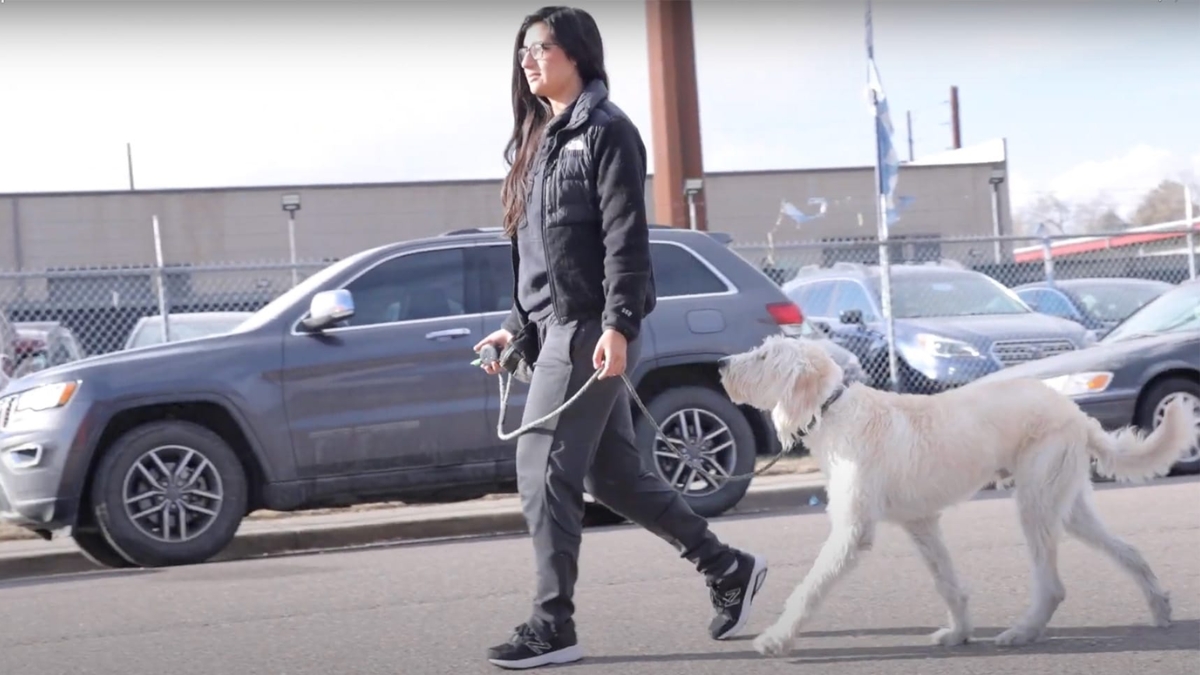
With anxious, fearful and aggressive dogs, we’re not only correcting bad behavior. We’re giving them a new behavior to focus on. On walks, we teach a heel: walking calmly next to you. Any deviation, whether that’s sniffing, inching ahead or lunging at a dog, is met with a correction.
When you’re anxious, having something to focus on takes the edge off, and dogs are the same. We don’t see dogs get more anxious or fearful with the e-collar. They deal with stressors a lot better.
Myth 1: “An e-collar will make my dog shut down”
I can see how that could happen. What causes shutdown is confusion: I feel this, I don’t like it, I don’t know why it’s happening or how to turn it off.
Our process is built to avoid that. Dogs learn the e-collar at low levels, where they can process it and see a way out. By the time we’re on higher numbers, they understand their behavior dictates it, so they don’t shut down. They understand they did something wrong.
Myth 2: “An e-collar will spike my dog’s aggression”
We can see this when a dog is past threshold: pulling, lunging and growling at another dog, and someone starts introducing an e-collar right then. That dog is already in the red zone. They might bite at the collar because they have no idea what’s happening.
I think in green, yellow and red. Green is a calm dog on a walk without a care in the world. Red is the dog I just described. So we keep dogs in a calmer head space to begin with, already in a heel or bed command around other dogs, and we correct the moment they start going from green to yellow. They look at a dog, get a correction and come right back to focus. We’re not waiting for something obviously bad. We’re maintaining the calm dog we already have.
If aggression is why you’re reading this, see my colleague Ian Lieberman’s guide on what to look for in a dog trainer for aggressive dogs.
Myth 3: “An e-collar will change my dog’s personality”
No. For better or for worse, we cannot change your dog’s personality. We can change behaviors, but we can’t genetically rewire who your dog is. Your happy Golden Retriever will still want to greet everybody after training; it should just be calmer. A German Shepherd lunging at people still has that desire after training, but it’s now more manageable. Your dog is still your dog.
Myth 4: “Only big, strong, aggressive dogs need one”
We see a tremendous amount of success with dogs of every size, from 8 lb Yorkies to 150 lb Mastiffs. Some smaller dogs are less sensitive to the collar than bigger ones, so a small dog isn’t automatically more fragile.
What about hot spots?
They exist. The metal contact points can irritate skin, like earrings can for some people. One of my dogs could wear the collar all day and never get one; my other two might if it sits in the same spot all day. Rotate the collar, watch it when it’s wet, and try different contact points for sensitive skin. Hot spots don’t come from the stimulation. A collar that’s never clicked can cause one.
Myth 5: “E-collars are cruel, and you can get the same results without one”
This is the big one. Probably all of our trainers believed it at one point, and then the truth got in the way. Whenever there’s a job to do, there has to be some consequence if it isn’t followed.
I think of my dog Willie. All I wanted was a Colorado dog I could take off leash, play fetch with and hike with. Willie had a different idea. I was the guy at Sloan’s Lake whose dog was chasing down joggers and barking at them, and if he saw a dog half a mile away, he’d run it down to say hi. It was embarrassing.
So I worked really hard on “Willie, come.” I had a long leash and treats, and I spent months on it. He knew what it meant, and he only listened when it was convenient for him. Feeling backed into a corner, I bought an e-collar, and it made me nervous. I said “Willie, come,” he ignored me because of a distraction, I kind of closed my eyes and clicked the button, and Willie turned around and ran to me. Still my buddy.
That’s when I realized these tools would give me the freedom I wanted with my dog. None of us woke up one day believing in e-collars. It comes from experience, and it’s the foundation of our off-leash dog training.
Why every trainer on our team uses one on their own dogs
All of our trainers use e-collars daily with their own dogs. It’s waterproof, so my dogs swim in it, it works on hikes, and it reaches half a mile. It gives us peace of mind, and it means our dogs get the freedom they’ve earned.
I understand the fear that a collar could damage your relationship with your dog. We see the opposite. What damages it is not being on the same page: yelling to get your dog to listen while they don’t understand what you want. Our training isn’t about tricks. It’s about getting your dog with you.
How the e-collar fits into our 21-day board and train
Your dog lives at our academy for 21 days and trains three to five sessions a day, with one trainer working four dogs at a time. The e-collar is layered in through the process above, and before your dog comes home we teach you to use it. Your dog keeps wearing it at home, because good training is clear and consistent. After graduation, lifetime support means you’re not figuring it out alone.
See how our 21-day Denver board and train program works, or watch the full consultation video series, including the chapter this article comes from.
FAQ
Do e-collars hurt dogs?
The stimulation is meant to be felt, and at times it’s uncomfortable; we’re honest about that. Dogs learn it at low levels first, so they always know how to turn it off with their own behavior. Hot spots come from the contact points, not the stimulation.
Is an e-collar the same as a shock collar?
People often call it that. The Mini Educator we use works on the same principle as a TENS unit and adjusts from 0 to 100, so we can find the level where a dog notices it and can still think. How it’s taught matters more than what it’s called.
Will my dog have to wear the e-collar after training?
Yes. Good training is clear and consistent, and removing the e-collar removes your ability to be consistent. We show you how to use it before your dog comes home.
Will an e-collar make my reactive or aggressive dog worse?
Introduced on a dog already in the red zone, a dog may react to the correction. That’s why we keep dogs in a heel or bed command around triggers and correct as they drift from green to yellow. Done that way, we don’t see dogs become more aggressive, fearful or shut down.
Can you train a dog without an e-collar?
Most of our trainers once thought so. In our experience, treats and a long leash get you a dog that listens when it’s convenient. The e-collar lets you set a clear expectation when a jogger or another dog is more interesting than you.
Ready to talk about your dog? Start a Conversation
Ready to talk about your dog?
Serving Denver & Longmont, Colorado · In operation since 2019