Dog Trainer for Reactive Dogs: How to Choose the Right One

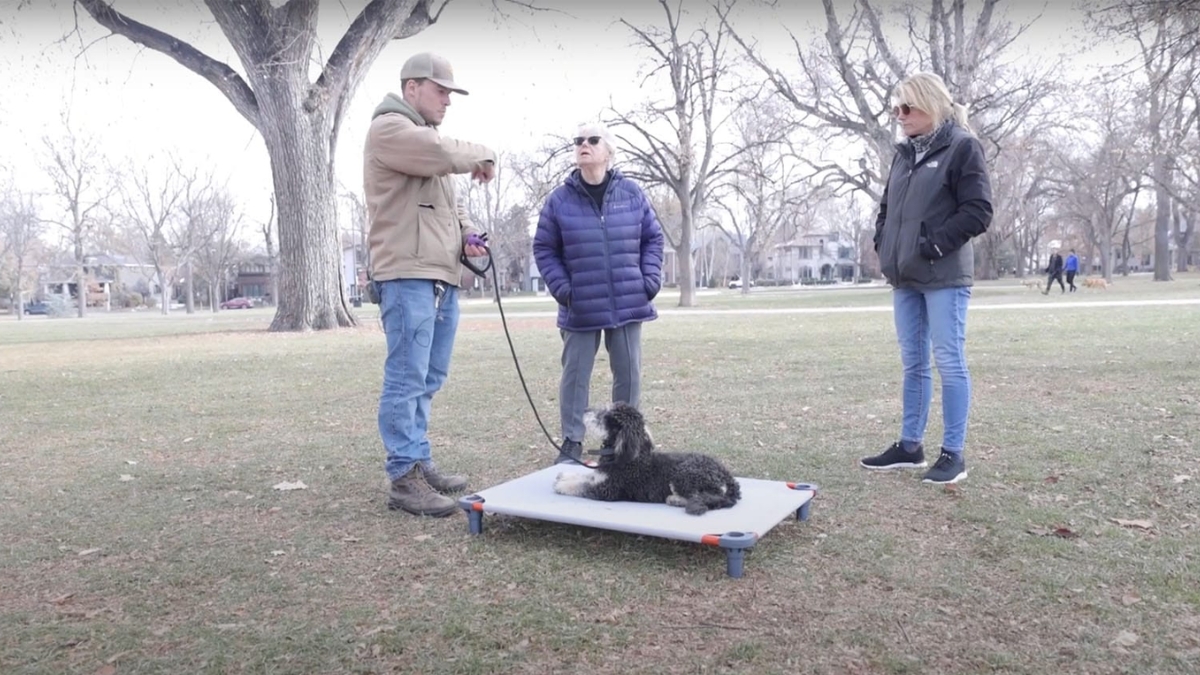
A good dog trainer for reactive dogs is honest that training manages reactivity rather than erasing it. Look for a method that holds up around real distractions, exposure that builds gradually instead of flooding your dog, proofing in public places, and a clear handoff that teaches you to run the system at home, with support afterward.
I’m Jamie Miller, co-founder of Art of the Dog Canine Academy. Reactive dogs, the ones who bark and lunge at other dogs, people or anything that moves fast, are a big part of what we work with in Denver and Longmont. This is how I’d choose a trainer if it were my dog.
Start with what a trainer can honestly promise
We’re often asked what to expect after training. The honest answer: we’re teaching you a line of communication with your dog, so your dog understands what’s expected and you have a way to follow through. You should be able to go to public parks and walk on a loose leash, with your dog ignoring distractions and holding heel, sit, down and come.
What training won’t do is change who your dog is. Your dog will always have certain fears or desires. We like to call ourselves an Ivy League school, but not everybody graduates at the top of their class. Dogs aren’t robots. We get every dog as far as they can go, and show you how to live with them.
My business partner Ian Lieberman sees a lot of training websites using words like fix, solve and cure, or the number 100%, and he doesn’t think that’s an accurate picture of what any trainer does. “Anybody saying that they can train aggression out of your dog, I would be skeptical,” he says. The same goes for reactivity. A trainer who promises your dog will suddenly love other dogs is selling something that doesn’t exist.
If you want the bigger picture of what reactivity is and where it comes from, start with our complete guide to reactive dog training. This piece is about choosing the person who’ll help you with it.
Why reactivity rarely gets better on its own
Most owners who reach out to us have been living with this for a while. Taking your dog anywhere becomes a chore, stressful for you and for your dog, so you stop going on walks and stop taking your dog places. Your dog gets less exposure to the world, and things get worse. Ian calls it a downward spiral, and it’s completely understandable.
A lot of reactivity is fear underneath, which is why your dog may seem sweet at home and like a different dog on the street.
If you adopted a dog with a history, you didn’t create this. And if there’s a young child at home and you’re no longer sure everyone is safe, bring in a professional now, not after the next incident.
5 questions to ask any dog trainer for reactive dogs
1. What happens when there’s a real distraction?
Almost any trainer can teach a sit in a quiet room. As Ian says, there’s a very big difference between a dog that understands concepts and a dog that will actually execute them. Understanding doesn’t equal compliance.
Treats, food and play are great for teaching, and we use plenty of them. The problem shows up in public, when something in the world is more exciting, or more frightening, than what’s in your pocket. That’s exactly where reactive dogs stop listening.
Ian learned this with his own German Shepherd, Ulf. He spent months on counter-conditioning with a reward-only behaviorist and did all his homework. One day Ulf was barking and growling at a passing dog with hot dogs flying everywhere, and Ian’s brother Will said, “Dude, I got bad news. This is not working.” Ian tells the rest in our guide to choosing a dog trainer for aggressive dogs.
So ask any trainer how their method holds up when the trigger is right there.
2. How do they build up exposure?
Exposure matters, but it has to be the right kind. What you don’t want is flooding. As Ian puts it, if your dog is afraid of lawnmowers, you don’t take him to a lawnmower factory on day one.
A good trainer first teaches what’s expected, like staying calmly in a heel. Then they work past the trigger at a distance where your dog can still focus, and close the gap over time, a lot like controlled exposure therapy. Your dog sees that nothing bad is happening and that all they need to do is follow your lead. (Our fear aggression guide walks through it step by step.)
3. What tools do they use, and can they explain why?
We’re a balanced training program: rewards, clear expectations and accountability, using e-collars and prong collars alongside a lot of positive reinforcement. Owners of reactive dogs often ask whether that equipment will make things worse. It’s a logical question. In Ian’s words, the equipment lets us “get control over our dog’s head space,” so we can work around the things that trigger them. Here’s how we use the e-collar and why it isn’t cruel.
Whatever the method, a trainer should show you the why. And whoever you decide to work with, even if it’s not us, you have to be completely comfortable with the trainers and the tools. Your dog will respond to you to the extent that you use the system they learned. If you won’t use it at home, it won’t hold.
4. Does the training leave the building?
Reactivity happens on the street, so ask where your dog will actually train. In our program, the first half is teaching at the academy. The second half is proofing: structured walks around other dogs and people, park trips around Denver, and Wash Park, which is full of distractions. The rules have to hold everywhere and with everyone.
5. What do they teach you, and what happens after?
I’d push hardest on this one, because your dog is coming home to you, not to the trainer. When your dog goes home from us, you get a list of commands, how to ask for them, and how to follow through. That removes the confusion. If you or your dog are confused, it creates frustration, and frustration leads to bad moments.
At graduation we show you everything your dog has learned and how the tools work, then hand you the leash. You go home with a homework packet and troubleshooting videos, and if you hit snags, our support team is there: unlimited follow-ups and one-on-ones for life if your dog drifts back toward old habits. That’s our lifetime support.
Red flags when choosing a reactive dog trainer
- They promise to fix or cure reactivity, or quote you a 100% result.
- No clear answer for what happens around real distractions.
- Your dog goes straight into the deep end with their trigger.
- Training only happens indoors or in a quiet yard.
- No plan to teach you, or support that ends at pickup.
- They can’t explain the why behind their methods.
What life looks like with a trained reactive dog
I feel personally that a well-trained dog who isn’t very social, but knows the commands, the rules and the system, can do a lot more, in a lot more environments, than a friendly dog who doesn’t listen. That’s what we mean by opening doors.
Your part is being your dog’s advocate. When someone’s friendly dog comes running over, Ian politely steps in front of Ulf, keeps a buffer, and asks the owner to leash their dog. A dog who’s barking and lunging is advocating for himself. When you advocate for him, he doesn’t have to.
Two owners of reactive graduates put it this way. Tu, Goose’s owner, didn’t want “to have to stress out about if we’re going to turn the corner and run into a dog.” After the program: “It’s a lot calmer in the household for sure. There’s a lot less frustration on my end.” And from Carly, Banks’s owner: “We love going for walks with him now. We love going on hikes and exploring Colorado together.”
Reactive dog training at Art of the Dog Canine Academy in Denver
Art of the Dog Canine Academy has one program: a 21-day live-in board and train, run out of two academies, one in Denver and one in Longmont. We’ve trained more than 4,000 dogs since 2019.
Your dog trains every day, weekends included, with 3 to 5 sessions a day: 65 to 100 sessions by graduation. Each trainer works with four dogs at a time, where the industry standard is closer to ten, and your dog’s primary trainer sends you video and photo updates along the way.
If reactivity is shrinking your dog’s world, see how we approach reactive dog training in Denver.
FAQ
What does a dog trainer for reactive dogs do?
A dog trainer for reactive dogs teaches your dog a clear system of communication, then uses it to work around triggers like other dogs, people or bikes in a controlled way. A good one also teaches you to use that system, so the calm behavior holds on your own walks.
Can a reactive dog be cured?
Not in the sense of a dog who suddenly loves their triggers, and be skeptical of anyone who promises that. Your dog will always be themselves. Training changes how your dog behaves around triggers and how well you manage those moments, which opens walks, parks and visitors back up.
How long does it take to train a reactive dog?
Our live-in program is 21 days, with 65 to 100 training sessions: enough time to teach the expectations and then proof them in the real world. After that, the work continues at home with you, which is why the handoff and ongoing support matter as much as the training.
Is board and train good for reactive dogs?
It can be, because of volume and consistency. Your dog gets several sessions a day with professional trainers who handle them the same way every time. As Ian says, the enemy in dog training is a lack of clarity. Make sure any program includes real-world proofing and a proper handoff to you.
Will my reactive dog be able to go off-leash?
Our graduates are off-leash trained, but off-leash is the ultimate freedom and it has to be earned. Start on leash, make sure your dog is following your lead, and build up slowly. If your dog has aggression of any sort, keep the leash on, because the consequence of a missed recall is too high.
Ready to talk about your dog? Start a Conversation
Ready to talk about your dog?
Serving Denver & Longmont, Colorado · In operation since 2019